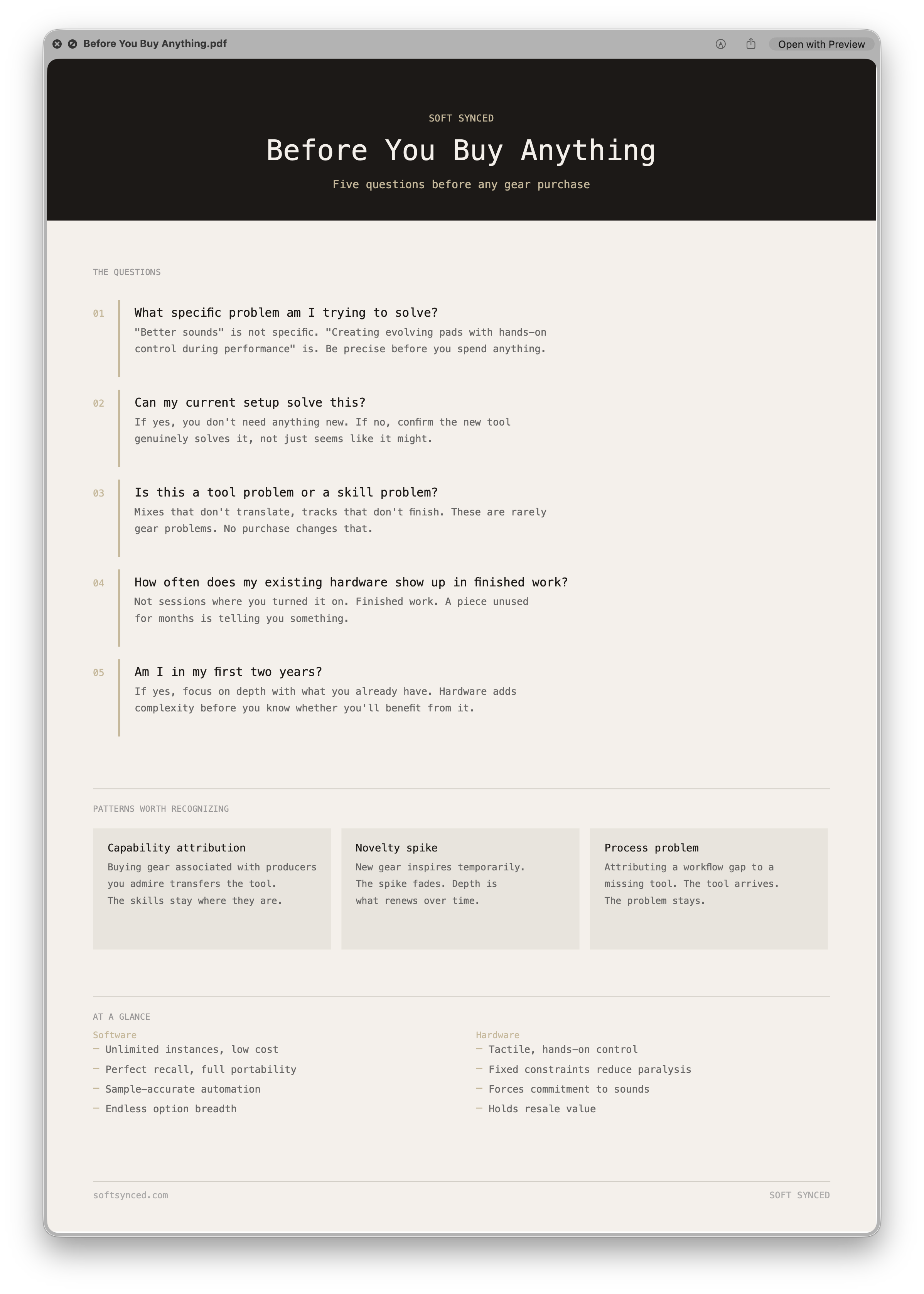
Five questions to ask before any gear purchase.
Most gear decisions feel like capability decisions. They're usually skill decisions in disguise. Knowing the difference before you spend anything is more useful than any buying guide.
This chart maps the five questions worth asking — starting with what problem you're actually trying to solve — alongside the three acquisition patterns that send most producers in the wrong direction: capability attribution, novelty-driven inspiration, and treating a workflow gap like a tool problem.
On the back: a software vs. hardware summary covering what each approach actually offers, stripped of the arguments that don't hold up.
Print it, keep it somewhere visible. It's most useful the moment you start convincing yourself you need something.
By the time a track reaches mastering, the mix has already been rendered down to a stereo file. The individual elements are combined into one signal. Every decision made at the mastering stage happens to everything at once. There is no isolating the bass from the vocal, or the snare from the reverb. Mastering works with what it receives.
Understanding what each stage of the chain is actually doing — and when it's warranted — changes how you use it. Reaching for a multiband compressor because it's in the chain is different from reaching for it because a specific frequency band is behaving differently from the rest. The same goes for saturation, stereo width processing, and the limiter.
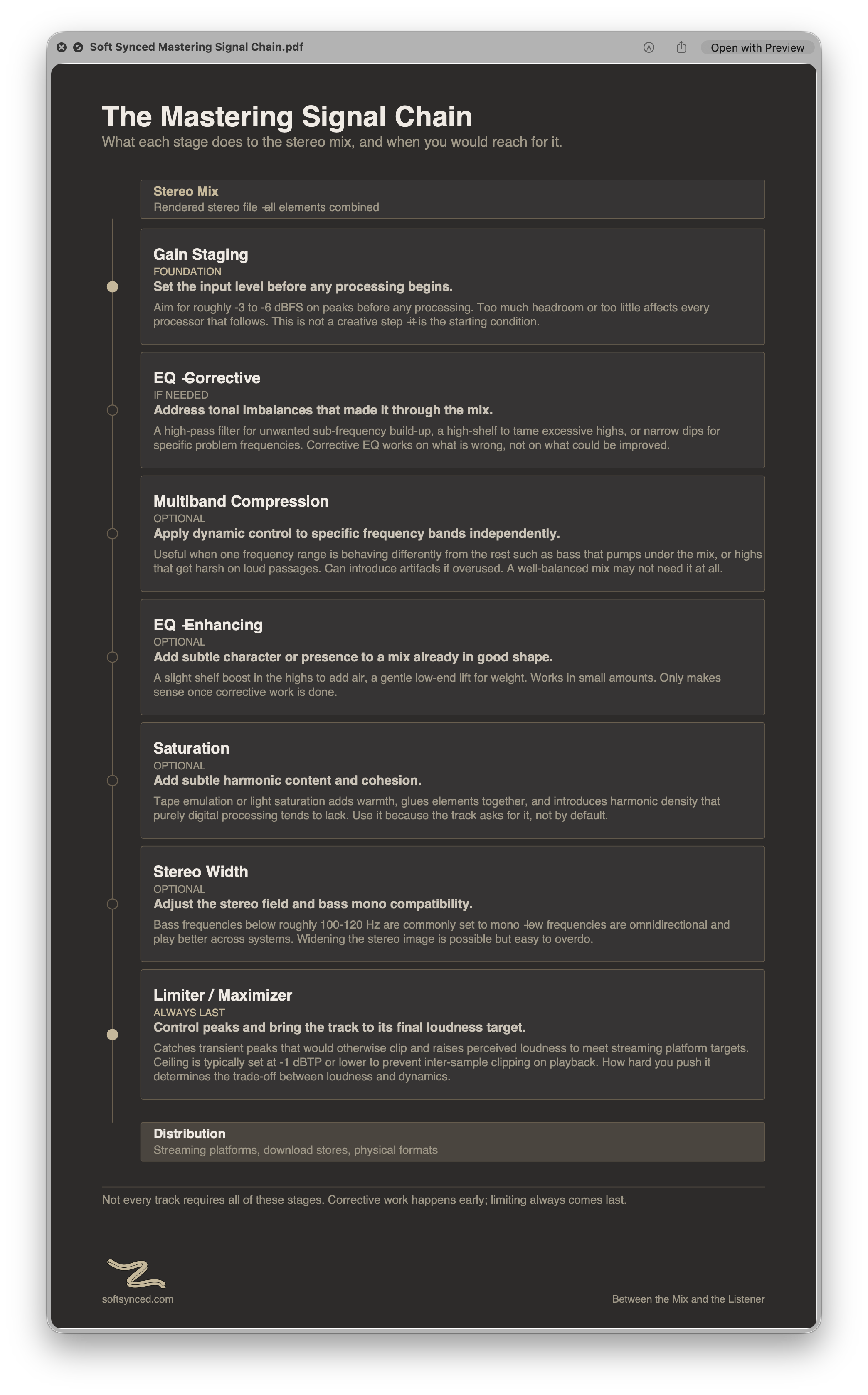
This chart maps the signal chain from stereo mix to distribution: gain staging, corrective EQ, multiband compression, enhancing EQ, saturation, stereo width, and limiting. Each stage is labeled by what it does to the signal and tagged by when you would actually reach for it — foundational, if needed, optional, or always last.
The distinction between corrective and enhancing treatment runs through the whole chain. Some tracks arrive needing correction. Others are already in good shape and only need a light enhancing pass. Most need some of both. The chain is the same either way, what changes is how much of it you actually use, and how hard you push each stage.
Not every track needs every stage. This chart is designed to help you make that call rather than defaulting to a full chain regardless of what the material asks for.
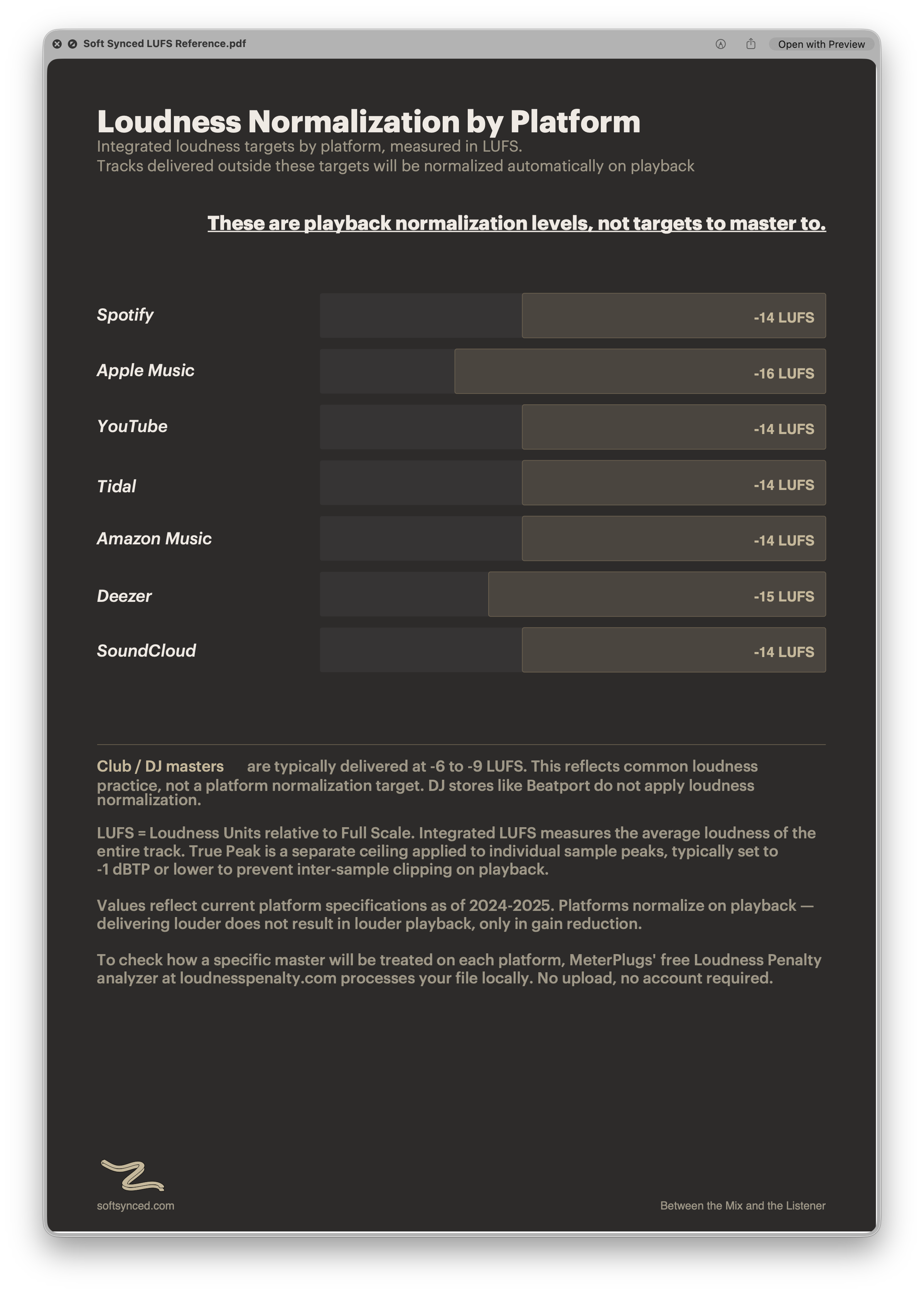
Every major streaming platform normalizes playback to a loudness level measured in LUFS. Tracks that arrive above that level get turned down. Tracks that arrive below it may be turned up within available headroom. Delivering a louder master does not result in louder playback but in gain reduction.
These numbers are not targets to master to. They describe how playback is adjusted.
Knowing how normalization works changes how you approach the final stage. Instead of chasing maximum loudness, you’re deciding how your track behaves once it gets turned up or down.
This chart shows the playback normalization levels for Spotify, Apple Music, YouTube, Tidal, Amazon Music, Deezer, and SoundCloud, along with typical True Peak ceilings. True Peak is separate from integrated loudness — it controls individual sample peaks, and setting it at -1 dBTP or lower helps prevent inter-sample clipping during encoding.
The chart also includes a note on Club and DJ masters, where the context is different and normalization does not apply. Treating Beatport the same as streaming platforms leads to the wrong decisions.
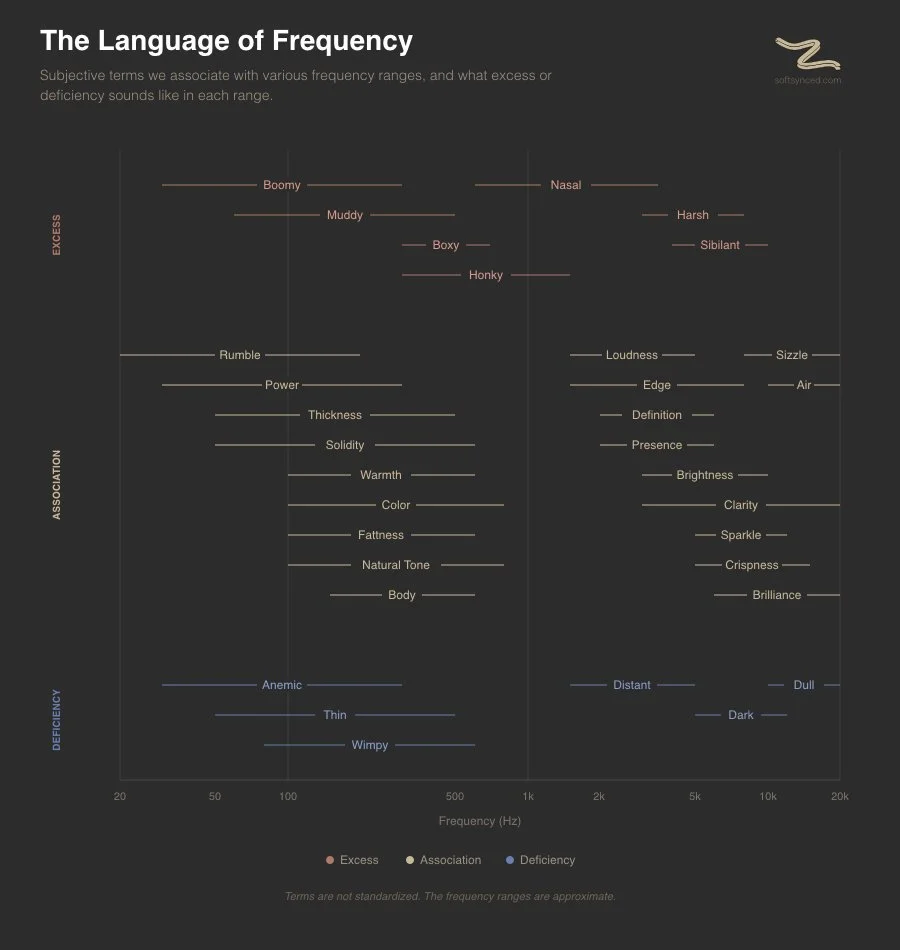
Subjective terms we associate various frequency ranges with, and excess or deficiencies in these ranges.
When someone says a mix sounds "boxy," they're talking about roughly 300–800 Hz. "Nasal" points to the 1–3 kHz zone. "Muddy" lives around 100–300 Hz. "Air" is up past 10 kHz.
These aren't standardized terms, different engineers use them slightly differently, and the exact frequencies shift depending on the instrument. But the general map is consistent enough to be useful as a shared language.
Roey Izhaki's Mixing Audio includes a chart that organizes these terms by what you hear when there's too much of a frequency range (excess), what you associate with it at normal levels, and what it sounds like when it's missing(deficiency). It's one of the most practical reference charts in any mixing book.
You don't need to memorize it. Just start connecting words to ranges. Once "harsh" means 4–8 kHz to you instead of just a feeling, you can act on it faster.
As Izhaki explains:
Izhaki, Roey. Mixing Audio: Concepts, Practices, and Tools (p. 230). (Function). Kindle Edition.
No results match your search. Try removing a few filters.
