 Image 1 of 1
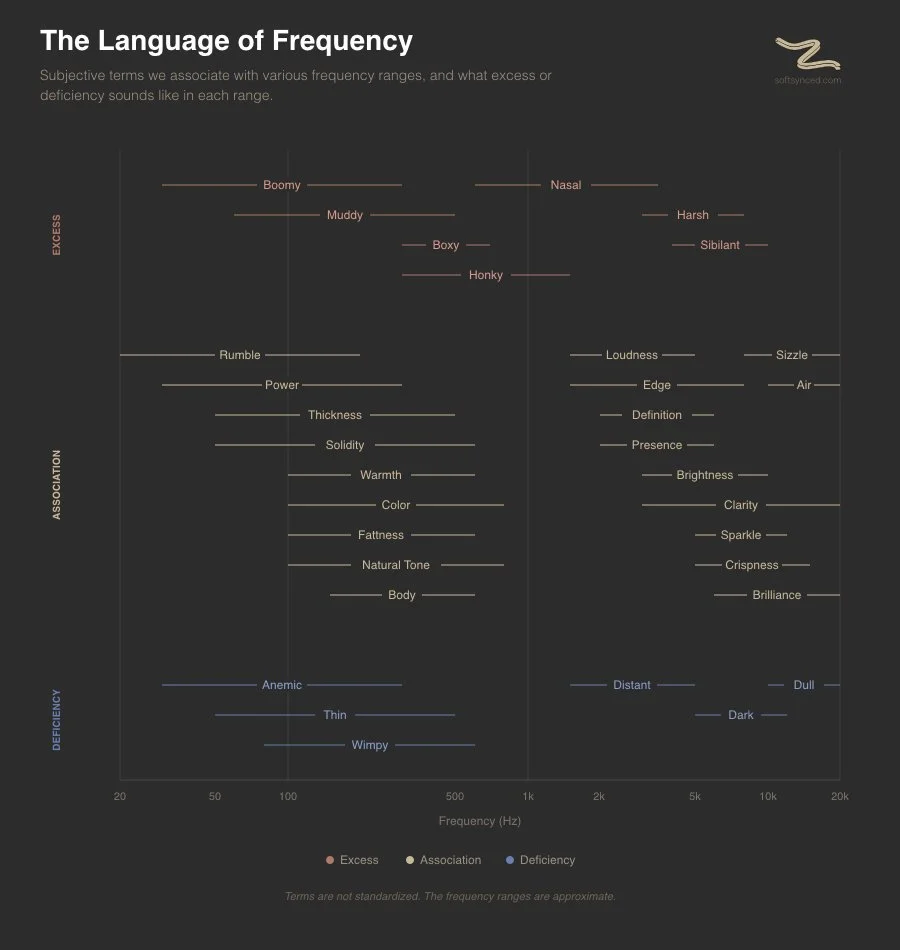
The terms are not standardized, and the frequency ranges are rough.
Subjective terms we associate various frequency ranges with, and excess or deficiencies in these ranges.
When someone says a mix sounds "boxy," they're talking about roughly 300–800 Hz. "Nasal" points to the 1–3 kHz zone. "Muddy" lives around 100–300 Hz. "Air" is up past 10 kHz.
These aren't standardized terms, different engineers use them slightly differently, and the exact frequencies shift depending on the instrument. But the general map is consistent enough to be useful as a shared language.
Roey Izhaki's Mixing Audio includes a chart that organizes these terms by what you hear when there's too much of a frequency range (excess), what you associate with it at normal levels, and what it sounds like when it's missing(deficiency). It's one of the most practical reference charts in any mixing book.
You don't need to memorize it. Just start connecting words to ranges. Once "harsh" means 4–8 kHz to you instead of just a feeling, you can act on it faster.
As Izhaki explains:
Izhaki, Roey. Mixing Audio: Concepts, Practices, and Tools (p. 230). (Function). Kindle Edition.
Subjective terms we associate various frequency ranges with, and excess or deficiencies in these ranges.
When someone says a mix sounds "boxy," they're talking about roughly 300–800 Hz. "Nasal" points to the 1–3 kHz zone. "Muddy" lives around 100–300 Hz. "Air" is up past 10 kHz.
These aren't standardized terms, different engineers use them slightly differently, and the exact frequencies shift depending on the instrument. But the general map is consistent enough to be useful as a shared language.
Roey Izhaki's Mixing Audio includes a chart that organizes these terms by what you hear when there's too much of a frequency range (excess), what you associate with it at normal levels, and what it sounds like when it's missing(deficiency). It's one of the most practical reference charts in any mixing book.
You don't need to memorize it. Just start connecting words to ranges. Once "harsh" means 4–8 kHz to you instead of just a feeling, you can act on it faster.
As Izhaki explains:
Izhaki, Roey. Mixing Audio: Concepts, Practices, and Tools (p. 230). (Function). Kindle Edition.
The terms are not standardized, and the frequency ranges are rough.